“Silicon Saxony” is the name for one of Germany’s most important innovation clusters for information and communication technology (ICT). It offers a powerful counter-vision to the narrative of deindustrialization in eastern Germany and shapes the economic development of Dresden, the state capital city of Saxony, and the surrounding region. Semiconductor chip production and the development of new generations of telecommunication technologies for the ever faster processing of ever larger amounts of data are at the heart of the clusters’ activities. Autonomous machines and robotics are important emerging application fields, as presented in the “Mensch, Roboter!” exhibition (2 Oct. 2026 to 27 Feb 2026), organised by the Barkhausen Institute Dresden, in the COSMO Science Forum in the Kulturpalast Dresden. Robots also come with sociopolitical visions. During the exhibition opening, Prof. Dr. Gerhard Fettweis, Vodafone Chair at TU Dresden and Scientific Director of the Barkhausen Institute, shared his vision that in the future, not only the rich, but also people with smaller incomes will be able to afford all sorts of services, which will then be delivered by interconnected, sensing and signaling robots.
Nevertheless, these digital futures do not appeal to everyone. In our ethnographic research on 5G, we have encountered societal groups that are critical, if not explicitly opposed, to the digitalisation of urban infrastructure and services. So, when the science communication team of the Barkhausen Institute Dresden [1] invited us to contribute to their robotics exhibition, we happily agreed to contribute by sharing our insights about societal responses to wireless communication infrastructure.
Developing a research-based game
We soon agreed to invent a format that would allow exhibition visitors to engage with the multiple realities of transforming ICT infrastructures in a city like Dresden. More precisely, we developed an interactive game in the style of a Krimidinner, that is, a Crime & Dine roleplay, that begins with a 6G blackout, which is followed by the question: Who did it? Who is responsible? Did someone sabotage the ICT infrastructure of the smart city?
The game builds on fundamental STS insights: breakdowns, including blackouts, are perfect for bringing invisible and often unnoticed infrastructures to the foreground. Breakdowns problematise invisible maintenance work. If they provoke controversies, for instance, in the form of controversial investigations around a sabotage act, they are likely to reveal the diverse and potentially conflicting interests, incommensurable future visions, and different obligations of the diverse stakeholders of sociotechnical transitions.
Thus, we designed an immersive roleplay that would allow the participants to adopt unfamiliar roles and enact conflicting positions. As a result, this fictional scenario, “6G Blackout in Silicon Saxony,” featured a techno-enthusiastic politician, a marginalised critic of 6G technology, a hacker, an industry representative, and a municipal maintenance worker whose invisible work and knowledge received little public attention.
Testing the prototype
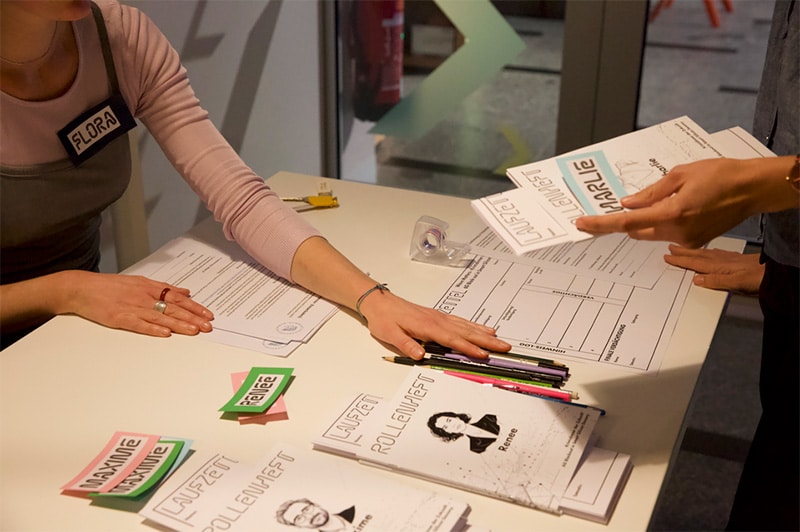
On 12 Nov. 2025, about five months after we had started the design process, fifteen role players assembled in the exhibition space of the Cosmo Science Forum to take their roles in the “6G Blackout” case. Upon arrival, each participant received a booklet with information about the scenario, their role, and instructions for the game. They also received a physical accessory related to their roles, the significance of which was revealed through hints during the investigation in the course of the game.
The characters are Renee, an ambitious politician; Maxime, an ICT manager; Bo, a maintenance expert; and Kim, who is accompanied by Charlie, who represent the critical voice of the public (the roles are outlined in more detail at the end of this post). They all engage very differently with ICT technologies and are critical of different aspects of 6G and its politics.
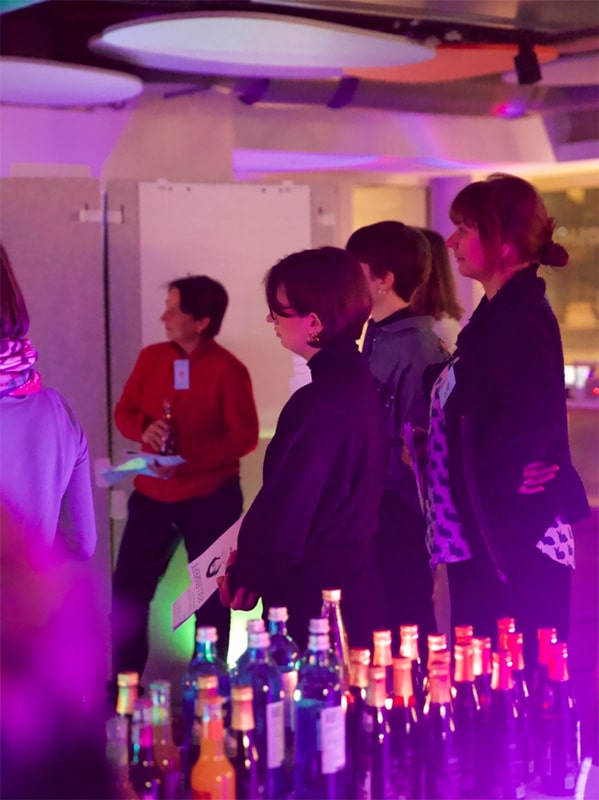
The setting is Dresden in 2040, where a retrospective on the early development of smart robotics is about to open. The evening’s host, played by one of the game organisers, opens the event with a welcome speech and a real buffet when the game begins. The lights dim to red, and an alarming siren sounds throughout the space. The sense of emergency intensifies when COSIMA, the fictive city’s AI, announces that the 6G network, the ICT backbone of Silicon Saxony, has failed. The prerecorded voice of the AI further suspects that the blackout was the result of sabotage in the immediate vicinity of the exhibition space. Everyone in the room is a potential suspect.
The investigation
A robotic voice instructs participants on how to proceed, guiding them through each step of their journey. Working in groups, the participants try out different tactics to understand what had happened. The provided role instructions gave them information about their character, what they had done and not done, and clues about why and how other players may be suspects. In our facilitating roles as host (Leonie) and service robot (Nona), we both observe how the participants and characters defend themselves and debate others, but we also support the participants in their joint investigations. The game is structured through the pre-recorded interventions from the AI (COSIMA), which provide additional information for each round of the game.
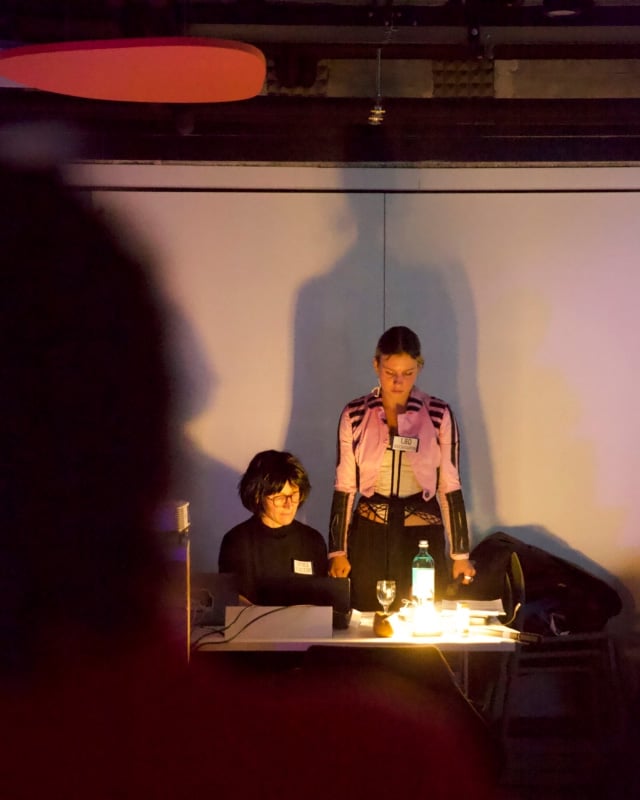
After three rounds of guessing and exchanging information, the AI announces the results of the investigation, explaining what caused the 6G blackout and who was responsible. However, at this point in time, the outcome and the culprit will remain our secret as we are planning to further develop the prototype and game. We can only say this much: The case is closely intertwined with core questions of sociotechnical and digital transformations, as well as infrastructural innovation, as discussed in Science and Technology Studies.
The game design challenge
The central challenge we encountered when developing the game was translating social-scientific knowledge into a thrilling plot and creating roles that embody diverse societal views on infrastructure, risk, and responsibility in typified but not stereotypical ways. How do you translate research results into a playable, thought-provoking, and exciting roleplay that sparks curiosity?
In the difficult moments of the design process, we could rely on Flora Halbert and Lucy Marlow, experts in game development, who guided us through the process, often providing advice. They helped us transform abstract research into a playable plot and tangible props, iron out plot inconsistencies, and design the role booklets.
For 6G-related facts, we interviewed experts from the Barkhausen Institute and Technical University Dresden. Their feedback was extremely helpful and also made clear that even those developing wireless technology can sometimes only speculate. When we tried to pin down what 6G actually is, the experts who were at the forefront of developing it suggested that there was much scope for imagination. This openness formed the basis of our approach: collective speculation instead of authoritative knowledge transfer.
After the trial
The first trial of the prototype in November 2025 was a success. Yet, it also revealed how we can still develop and improve the roleplay experience. Following plausibility and dramaturgy tests with colleagues, the roleplayers in Dresden provided invaluable feedback on how to improve the plot, structure, and conclusion of the game.
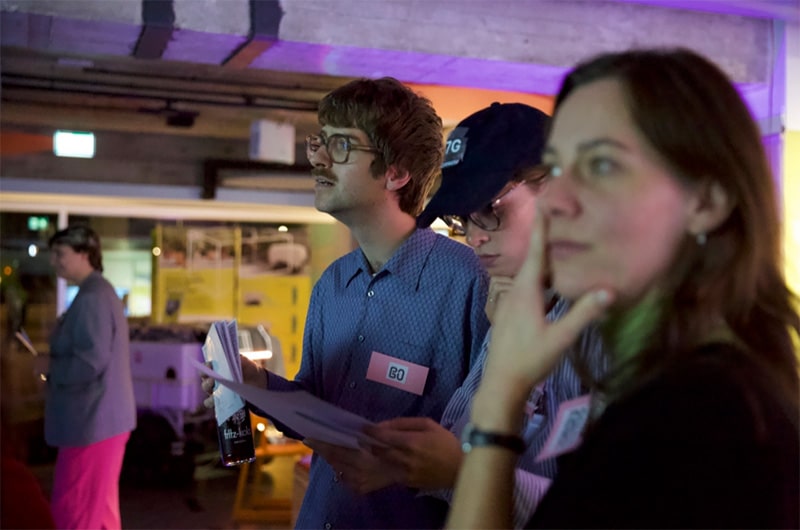
So what’s next? First, we are actively looking for funding to develop the prototype into an off-the-shelf product. In particular, we see a great potential for the interactive, immersive format in science communication contexts, including educational settings and public engagement with science and technology. The feedback to the prototype trial suggests that the immersive approach can indeed facilitate dialogue and conversation in ways that traditional formats often cannot.
After all, to imagine a technological future that has not yet been written is oftentimes difficult. In this regard, the 6G-Krimidinner [Crime & Dine] roleplay facilitates collective thinking processes and playful disputes. More precisely, the format creates a space in which players step into roles that they did not choose, navigate dilemmas that they have not rehearsed, and negotiate futures that do not come with a script.
The Krimidinner roleplay also connects to our other WAVEMATTERS experiments: the Bus Tour in Madrid, the Noise Experiment in Barcelona, and the the 5G walk through Dresden. All of these explore how we experience and relate to the invisible infrastructures around us and that “wireless” is never really wireless. Behind the network there are cables, maintenance workers, authorities, politics, and care structures.