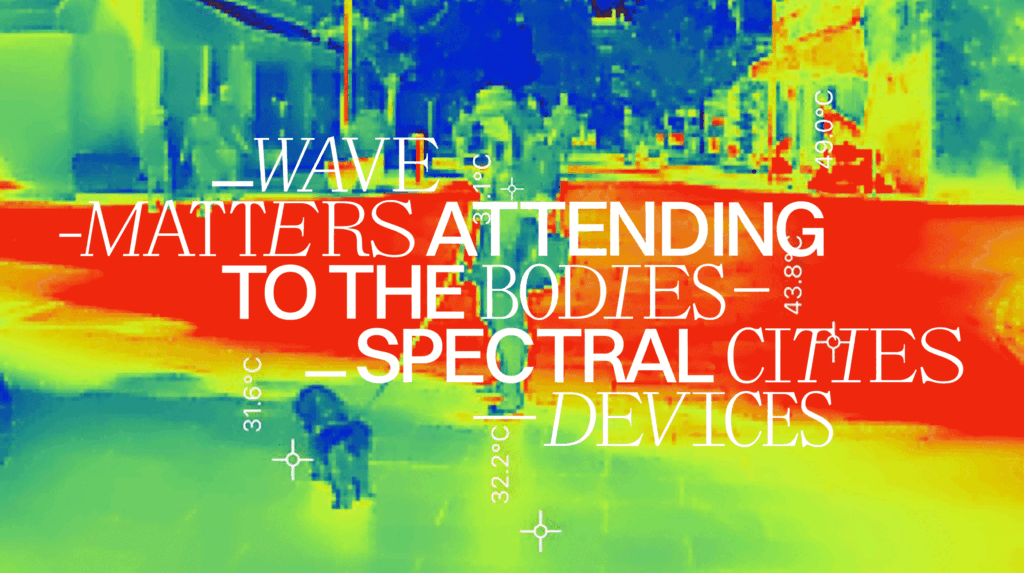
Photo Credits: Elisabeth Luggauer, Heike Zappe, Jeremy Knowles, Brett Mommersteeg, Bruitparif, Bell (1980)
Opening: 01 October 2026, 6-9 pm
02 October 2026 — 13 February 2027
TA T – Tieranatomisches Theater
Philippstr. 13 10115 Berlin
Tuesday – Saturday, 2-6pm
Free Admission
German, English
Waves matter. They light our streets at night, carry our voices, grow our food, send our text messages. Sound and electromagnetic waves are the ever-present, invisible forces that shape social life — connecting people, landscapes, and artifacts. And yet, we lack a language to talk about how they affect us, even as they become matters of concern. Think of the radiating heat that makes life unbearable, the wireless signals that enable dystopic futures, or the environmental noise and artificial light that burden human and non-human health.
At the same time, we are surrounded by wave matters: speed bumps that reduce traffic noise; rooftop antennas that transmit 5G signals; curtains, clothing, trees and new types of pavement that block, reflect or refract radiant heat. But the connection between waves and their matters is neither simple nor stable. Waves mess with bodies, with cities, with devices — their effects are vague, difficult to put into words, and hard to trace. Between physics and politics, they do not only attend to the spectrum. They are also spectral.
This exhibition explores how waves come to matter. It invites visitors to experiment with three modes of attending to the spectral. A sensory mode that plays with the thresholds of perception through works produced with collaborating artists. A narrative mode that reconstructs contentious scientific theories that unsettle established understandings of the human body and the boundaries between the senses. And an ethnographic mode that presents things that materialize waves in different ways and tell stories about how people and cities relate to them in everyday life.
WHAT TO EXPECT
At the centre of the exhibition is the Cabinet of Waves, a multimodal device that exhibits “wavy objects” that were collected during fieldwork in the Wavematters research project. In the exhibition space, each object is set in relation to its own context, narrating how waves are materialized and problematized in cities. It includes, among others, stories of how prickly plants regulate recreational noise in Barcelona, court cases become sites of protest against 5G in the UK, fashion changes in Japan to adapt to heat, or how insects are protected against the light.
Five artistic positions challenge us to attend to the ever-present, yet often unnoticed waves that surround us through our senses.
In a video installation, Amor Schumacher and Summer Banks present fragments of conversations about how heat unsettles our everyday lives in different ways
Through two works sound artist Mathias Klenner transports the background noise of a square in Barcelona into the main exhibition space and asks us to experience the slippery thresholds of perception between sound and vibration in a walk-in vitrine
Merche Blasco invites guests to take custom-made electromagnetic instruments around the TA T building to listen to its electromagnetic hum
Jeremy Knowles inserts us into the perspective of a pond in Görlitzer Park at night as it is disturbed by artificial lighting
ooooo, a techno-feminist transuniversal constellation, troubles conventional ways of imagining how bodies relate to electric fields through different kinds of antennas
Two interactive wall installations reconstruct contentious scientific theories around the sense of vibration and the body’s bioelectricity. They document the search for a sixth sense — vibration — and the idea of a body shaped by electric currents.
EVENTS
Sound artist Merche Blasco will perform on 10 November 2026 at 8 pm, part of Berlin Science Week 2026
Guided tours by members of the Wavematters team on 10 November 2026, 8 December 2026, and 12 of January 2027.
CREDITS
Curators: Jorge Martín Sainz de los Terreros & Ignacio Farías (IfEE, HU Berlin)
Curatorial Support: Felix Sattler & Paz Ponce (TA T – Tieranatomsiches Theater)
Ethnographers: Brett Mommersteeg, Nona-Schulte-Römer, Jorge Martín Sainz de los Terreros, Ignacio Farías/Albert Arias, Elisabeth Luggauer & Margherita Tess (IfEE, HU Berlin)
Historical Research: Brett Mommersteeg (IfEE, HU Berlin)
Artists: Summer Banks/Amor Schumacher, Merche Blasco, Mathias Klenner, Jeremy Knowles & ooooo
Exhibition Design and Production: Jorge Martín Sainz de los Terreros & Ignacio Rivas
Graphic Design: Studio Katja Gretzinger with Carole Bieri, Alix Alyosha Filipović, and Emilia Kaspar
Fabrication and Installation: Ignacio Rivas, Fanny Welz, Eisenholz, Schellenberg, Mark Stroemich, Andras Breuer & Sami Ben Larbi
Multimedia Design and Installation: Mariano Rosales (Die Luftfabrik)
Student Assistants: Leonie Schramm, Valentin Watermann, Finn Dittmer, Florence Rusca, Isabel Bunce
Funded by the European Research Council (ERC)