We have spent the night in Zierenberg near Kassel at a campsite. Early in the morning on June 29, we start climbing uphill in bright sunshine to a venue called Lebensbogen (bow of life) on Dörnberg. On our 45 min walk we pass meadows, horses and woodland. It’s a quite unusually idyllic place for urban anthropology fieldwork. But it’s no coincidence that there is not an easy public transport connection up to the venue: Electrohypersensitive (EHS) people choose remote places for their gatherings as they want to escape “civilisation” which nowadays coincides with invisible electromagnetic fields. And yet, due to the airport nearby, this area is not completely free of wireless signals and electromagnetic fields; it is not a pure “white zone,” but as the website warns, a “white zone area with grey dots” – or as the organisers declare, while not perfect, it is nevertheless “agreeable” – these, perhaps, are “safe connections.” As we get closer to our destination, the annual gathering of European Electrohypersensitives (EHS), little flags of European countries and cars with foreign number places guide us the way.
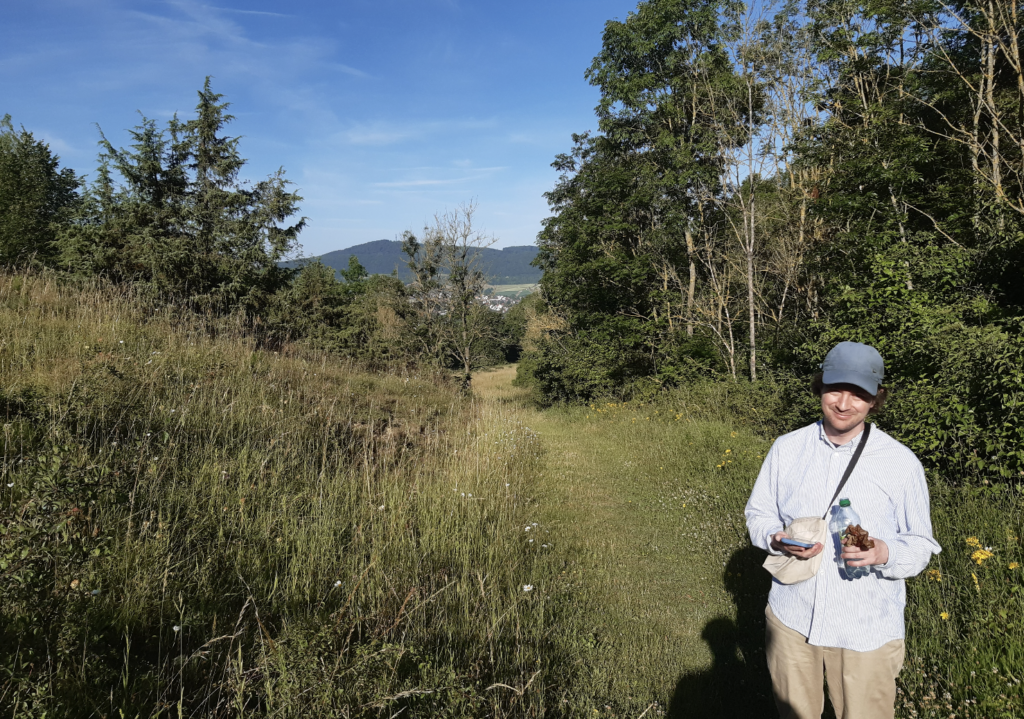
7:45 a.m. – we still have mobile connection and use Brett’s smartphone to find the fastest way to the venue.
It is the first EHS conference in Germany, following two gatherings in [Rièzes](https://wavematters.eu/into-the-white-zone/), Belgium. This time, the rather new activist network Europeans for Safe Connections has taken the lead. The conference programme in English, German and a bit of French runs in two parallel tracks and offers an overview over EHS-related topics including science-oriented talks on electrohypersensitivity, the biological effects of EMF on insects and trees, video screenings and yoga sessions. On day 2, there will be working group meetings, but we can only stay on Saturday.
The conference mainly takes place within buildings at the back of the site, down a hill that we walk down, crossing a bridge that spans a small brook. Out front of these buildings, people mill around with coffee, chatting. A sign outside of the entrance to the building where the conference will take place reads: “No Smart Phones. We are Smart (PH)ONES”. Elsewhere, there are other signs reminding us to turn off our phones. To avoid irritations, we too keep our smartphones in our pockets, turned off, and do not take pictures in the conference area.
The atmosphere is convivial, but also industrious. This is not just a gathering to meet and mingle, to comfort and support each other, but also a conference that is meant to inform, educate and inspire political action. As researchers we are familiar with such conference formats as we go to the academic events of our discipline, and we have also visited 5G conferences and science-based risk governance conferences organised by institutions that electrohypersensitives do not trust. In this EHS event, however, we feel a strange-familiar affect, and it takes us a while to locate our unease.
The conference day begins with a cheerful “Welcome” talk from the President of the Europeans for Safe Connections, which is translated into French and German. He introduces the schedule and mentions that there will be “Working Groups” on Sunday, and stresses one in particular, regarding the UN special rapporteur on disabilities; they are seeking “legal people” to help them write to the UN. Later, in two of the talks, this category is problematised a little: is it a disability? Implicit in this question is another question that, we find, runs throughout the conference: how do we talk about EHS? According to which category? What will help EHS people become recognised, recognisable, legible? Which category do we, people with EHS, identify with? And in which way? In order to make the most of our day, we decide to split up. Nona attends the German track, Brett the English.
How to talk about how to talk about EHS
The talks in English are held in the large room. While most of the people remain in their seats, others stretch out on cushions on the floor, a few sit on the sofa at the back of the room. At the front, there is an electrical set-up for the audio and video documentation of the talks. In front of me, a woman shows another woman the printout of a newspaper article – they both shake their heads in disapproval; I can hear another discussing the pluses and minuses of their measurement device that she was using to check on the status of the room.
From 9.40 a.m. to 5 p.m., there is a series of talks touching on a diversity of topics, from functional medicine to the effects of EMFs on insects, from an update on the state-of-the-art of EHS research to how to politicise scientific studies and a report on three studies on the effects of non-ionizing radiation on DNA and cellular processes.
The first talk is from a medical practitioner. She runs a “functional medicine” clinic in Denmark, and she notes at the outset, that she is an expert in clinical nutrition with 15 years of experience treating people with EHS and is interested in protection from “wireless tech”. She speaks well. She undoubtedly has experience speaking publicly. She tells us that she too had EHS, but that she has learned how to live with it. This is an important part of her talk: learning how to live with EHS in a world that is and will be full of electromagnetic waves and wireless signals. She wants to share her experience of treatment, of learning to live in a world “permanently polluted” with electromagnetic waves, as our colleagues might put it.[1] At one point, she admits that she relies on her iPhone as a “safety blanket” – she’s addicted to it – she mindlessly scrolls too – and she knows that it will make her feel unwell; we need to be honest with ourselves first before we can change our behaviours. And yet, there are ways to protect ourselves, ways to better ourselves. “Do not identify with the disease,” she tells us. “It’s not you: you can fix it!” There is a vacillation between the optimistic and the therapeutic and reminders of the negative effects of electromagnetic waves – between the good and the bad waves.
A mixture of scientific and political
Her talk is partly motivational – you are not your disease! Here is how you can treat yourself! – and partly informative – here are studies that are, in her words, “scientifically valid” that demonstrate the effects of EMF on bodies and health. Lining the talking points she offers the audience, is a series of scientific studies. Following a study about the relation between the rise of cell phones and the number of people calling into sick at work in the 1990s, studies about the rise of obesity, ADHD, autism, and other neurological issues, of prenatal diseases in the 1980s due to the increase in microwave use, she poses an unanswered question, which is the refrain in her talk, to us, the audience: “is it correlation or causation?” A question to which everyone here already has the answer: they can feel it.
The talk invokes other noted biological effects of electromagnetic waves: direct and indirect DNA damage, the rise of free radicals, peroxynitrites, effects on sperm, genetic traces of damages across generations, blood-brain barriers opening up to let environmental toxins in, frontal cortex shrinkage, lack of immunity to other diseases. In this question of causation or correlation, and in the series of studies and described biological effects, there is a sense of a disjuncture invoked: of living in a world without the means to describe it, of searching for signs and categories to make these experiences legible. Due to this disjuncture, she cautions about charlatans who exploit people with EHS, but also that they cannot rely on the authorities to protect them. At the same time, she emphasizes that “science progresses,” that “science” is lagging behind, and that it will catch up. Soon the correlations will be shown to be causes. That there is a “thinking problem” in the field of medicine, that it “takes too long for models to change, to be updated”. They are waiting for these models. Social scientists would speak of ‘undone science.’[2] Official risk assessors would reply that the research is being done, but potential biological effects have not yet been properly validated.
The EHS doctors’ talk is full of technical details that are admittedly difficult to follow, to note down. It bridges a large swath of biological terms and details that draw connections between the abstractions of the cellular and neurological and the everyday experiences of having EHS in a world that is increasingly wireless. These details and connections accrue during the day. The other talks are full of references to other studies, past and ongoing, experiments and reports, scientific reviews, to “validated science” and facts. They overflow with terminology – cryptochromes, free radicals, microtubules, genotoxic and cytotoxic effects – whose significance is challenging to hold onto. Each talk is a mixture of the medical and scientific, of politics, the cosmological and the everyday. From how to speak to politicians to understanding how to paint your walls to protect from wireless signals, of being electric to how routers intervene in the worlds of bees. Each a reflection on what it means to become hypersensitive: aside from being the markers of its existence, they are also accounts of searching for the right ways to talk about EHS.
Scientific complexity peppered with rhetoric skill
Meanwhile in a much smaller, quite crowded room, a German-speaking audience listens to key figures of the anti-wireless communication movement in Germany. The first presentation by a spokesperson of Diagnose Funk starts late as the opening plenary went over time. Now, two women have detected an electric field with their EMF meters and are searching for its source in the packed room. “Did everyone switch off their mobile phones?” Especially iPhones, as they keep radiating in flight mode, the women explain. They suspect it might be the heating system that is sending wireless signals. A guy in the first row complains, impatiently: “is this always like this in such meetings?” Suddenly, the signal is gone and the speaker starts.
His presentation is clear and polemic. “The German Federal Office of Radiation Protection is the Federal Office that protects the radiation.” However, research that demonstrates EMF risks is ”completely ignored, negated and refused… that is what the argument is like out there.” His slides show a mixture of well-organised, but complex graphs and figures, and caricatures of politicians and our smartphone-addicted society. His “favourite graph” shows how modern communication technology has ‘filled up’ the gaps in the natural electromagnetic spectrum suggesting that “electrostress” is getting worse and worse in our everyday lives.
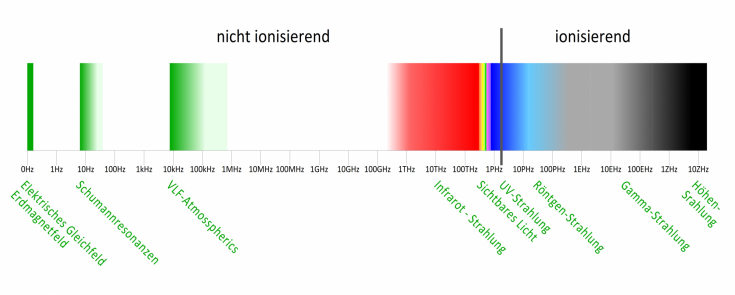
diagnose:funk, 2018, Elektrostress im Alltag: 6
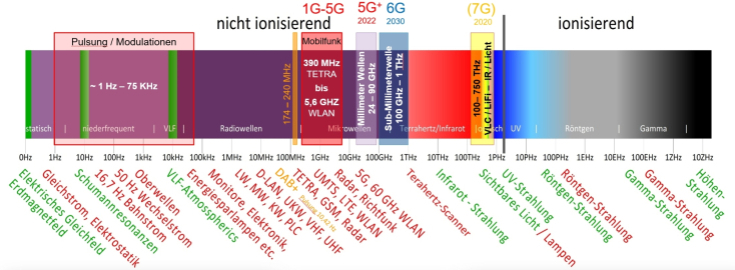
diagnose:funk, 2018, Elektrostress im Alltag: 7
The presentation is catchy and the speaker rhetorically strong. It’s easy to see why people decide to donate for Diagnose Funk and consider it as an organisation that speaks truth to power. However, it is also true that this speaker works as free architect and Baubiologe (building biologist) whose services include the measurement of physical fields in people’s homes and surroundings. Critics of the mobile communication critics therefore suggest that Baubiologie is humbug and its proponents profit economically from their engagement against wireless communication and EMF exposure.
However, this criticism cannot be said hold up against another renowned spokesperson of EMF risks who presents in the German-speaking room after lunch. The elderly gentleman is a physics professor and has also fought environmental pollution as a European politician. He is introduced as a distinguished scientist and presents a mix of scientific, legal, and political information on EMF risks and their insufficient governance.
An autoethnographic note
Since I cannot look into the heads of other audience members and have to leave right after the presentation, I (Nona) pay attention to my own reactions to the talk. While the professor’s science does not convince me, I learn a lot about rhetoric. To substantiate the claim that ICNIRP, the non-profit scientific body that recommends threshold limits for mobile communication signals, is in bed with the telecommunication industry, he illustrates that officials of the German government are part of ICNIRP. I fear that the flow of information during an oral presentation might cover the fact that there is a huge gap in the argument. Since when are government and industry the same thing? I was prepared to gain insider information about scandalous government-industry ties from an experienced politician, but now, I am not convinced. Instead, I feel I was to be fooled by words and slides.
The professor continues to present the research of fellow scientists, and the physicist speaks like an expert in cell biology. He explains that it is “surely true” that EMF causes cell damage by opening calcium channels, “but that is not all.” The vibrations of wireless communication can also damage the spiral-shaped segments of proteins, which has been shown by Niels Bohr’s grandsons. I realise that the name of the 1922 Nobel Prize winner leaves an impression on me. If the grandfather performed breakthrough research into the structure of atoms and the radiation they emit, his grandsons must know, right? Yet, then I remember that risk assessors have told me that “one study is no study.” You don’t find risks because your grandfather won a Nobel Prize, but because you are part of an interdisciplinary team effort of testing and verifying effects and explaining how exposure causes cell-level abnormalities that then add up to a harmful outcome for a living organism… Still, I don’t want my proteins to lose their spiraling power and risk assessments have looked into the effect since the Bohr grandsons published their article 24 years ago.
Unfortunately, I cannot stay for the discussion as I have to catch a train. A new acquaintance who identifies as electrohypersensitive natural scientist and has kindly offered to drive me down the hill tells me in the car that she is sometimes annoyed by the science communication by mobile communication critics. They too often present the studies of others in a grossly simplified manner. She does not think that the researchers who are conducting the research would be happy with the way their work is represented in such contexts.
Predatory nature…
Looking back at our day at the EHS gathering, we are well aware that we have missed most of the convivial parts of the event, especially the party in the evening. Maybe this is why we therefore felt that, in comparison to the Rièzes research experience, knowledge transfer and strategizing seemed to play a greater role. We would like to conclude our brief report of our time at the EHS gathering with a reflection on one way in which EHS was talked about, and the major role that science – studies, reports, terminology, and facts – is used to render legible the experiences of EHS. In her recent work on common sense, the philosopher of science Isabelle Stengers has also highlighted the ways in which “science” and its modes of abstraction have become a central apparatus for determining, regulating, and granting authority to epistemological claims at the expense of other experiences and knowledges. She has written about what she calls “predatory modes of abstraction” that are enrolled to patrol knowledge and delimit what one may legitimately know, that is used to mark out what is real and what is mere opinion, and the risks of mobilising the “objectivity” obtained within scientific practices as a means to disqualify or omit. This is the situation she refers to as the “defeat of common sense.” Thus, we wonder, if this reliance on “science” in these talks, this mobilisation of “science” as what guarantees legitimate experience, is symptomatic of this situation that Stengers calls the defeat of common sense? Is this the only way to talk about EHS? Or is this just one language or discourse mobilised in order to become legible and heard by those who, in turn, rely on these predatory modes of abstraction?
But we also witness other ways of talking about EHS happening at the gathering, in between the “scientific talk,” discussions of support and advice, of activist organisation based on care and community-making. In these other modes of abstraction, we can also see them bringing into existence other realities – not just “objective facts” – that in turn resist what seeks to disqualify them. Finally, we wonder – and perhaps the gathering is one instance of this – what other “generative apparatuses” for activating common sense could be imagined, apparatuses that enable mutual sensitivities, of bearing witness to experiences that cannot be reduced to whether or not it is a “fact” or not?