Adrian Mackenzie is a professor of sociology in the School of Sociology at Australian National University. His research investigates how contemporary cultures affect and are affected by technologies in a broad sense. It's sociological in that it draws on approaches from the social studies of science and technology, media and cultural studies, with a particular commitment to studies of software. His current research projects focus on platforms and platform sociology in the context of science and media, on biosensors and biosensing practices in the context of health and illness, and on data science-related transformations in knowledge in the sciences, education and government. He is particularly interested in methodological developments associated with platforms. He views and participates in these developments mainly in the form of digital sociology, but also by continuing work that has long been part of actor network theory-guided approaches in science studies.
1. A note on pulses and their time-places
The following entry traces the outlines of a waveform known as a pulse in the form of a 10 second note played at a concert by a so-called ‘wind’ instrument. It tracks the infra-vibrational components of the note as a pulse, or time-placed wave ensemble. Pulses are common waveforms that bear the marks of their own limits or finiteness. The ambit of discussion here is not so much to tell of the sociotechnical life of a waveform (e.g. stories of pulse-shaping in recent telecommunications) or to socialise breathing and its measures (e.g. in pulse oximetry), but to support forms of experimental ontology attuned to flows of air, including wind, breathing, voices, instruments, and rooms in their happenings. The note echoes Deborah Bird Rose’s call to think ‘impulsively’ in order to experience potential new modes of existence: pulses found in music, dance, painting, growth, ecologies and landscapes (Rose 2017, 54), and perhaps media and telecommunications. It also develops a line of thinking first sketched by Stefan Helmreich in a consideration of heartbeats and ‘propagation of impulses’ (Helmreich 2013, 139).
1.1 The long note and its many resonances
8.40 pm, 12 February, 1964, Philharmonic Hall, New York, in front of an audience of around 2000, a trumpet note, a high A lasting almost 10 seconds, rings out from the Miles Davis Quintet (Miles Davis 2015). The wondrous shimmering note excites a long, almost melodic shout from someone in the audience (Music 2025). The concert takes place as a benefit for the Mississippi Summer Freedom Project, a civil rights campaign focused on enrolling Afro-American voters in the southern states of U.S.A. The acoustic problems of the newly built Philharmonic Hall at the Lincoln Centre had not yet drawn public attention (Kimmelman 2022). In that long note at 1 min 45 seconds into the song and its answering cry, wrapped in all the resonances of the Philharmonic Hall, an excitable New York audience, the civil rights campaigns, and the many subsequent performances and recordings influenced by this famous concert, what can be heard or felt?
1.2 A surprisingly slight disturbance
Viewed in terms of wave propagation, the note is an immensely ‘lossy’ event. Breath itself, including blowing air through a wind instrument, is a complex sound wave, full of many variations in air pressure, as heard in many ASMR videos. Only 1% of the energy (maximum power somewhere between 10-30 watts) of the airflow passing across Miles Davis’ buzzing lips, themselves opening and closing at around 900 beats/second (900 Hertz), transpires as sound. Most of the highly modulated breath-waves heat air, warm the metal of the trumpet or spill out around the mouth piece or bell as breathy hiss. But in losing so much energy, a surprising deceleration and acceleration occurs. Air moving at around 100 m/s past the lips slows down in the instrument, and leaves the bell as a slow flow of air (0.1m/s). At the time, it also speeds up in becoming the fast pressure wave at 343 m/s, or the ‘speed of sound’. Whatever unfolds, in the millisecond interval between lips and the note phosphorescing at the bell of the trumpet bifurcates in acceleration and deceleration, a splitting of air into slow-moving and fast vibrating components.
Beyond the bell, a slender, ephemeral disturbance moving as a pressure wave with a power of a few milliwatts, ranges through the hall, compressing and rarefying air at various wavelengths (due to harmonics, resonances and other waveforms) but particularly around 34 cm for the A. For such a note, air moves backwards and forwards around 800 times a second across the assembled public, entraining various cochlear nerve impulses, cardiac waves, heart-rate variations and muscle-cell depolarizations, including those that culminate in that astonishing shout in response. Yet the pressure changes moving out of the bell are slight. The trumpet hardly affects the atmospheric pressure in the room. It repeatedly disturbs it fractionally, almost trivially it seems. The pressure variations of the note run at approximately 1 Pascal versus an ambient atmospheric pressure of 101,000 Pascal. In terms of pressure, it is like the weight of an 8cm air column versus roughly the 100km 1 square meter ‘air column’ of the Earth’s atmosphere at sea-level. Even if it reached 110 decibels, the note is not like the eruption of Krakatoa that, for instance, sent 300 decibel shock waves around the planet.
Continuing in the wake of a literal and naive physics of this note, we might drift slightly further into the instrument, and thus into the transductive zone of the note-event. The horn is a shaped air column whose height/length changes as valves are pressed. The relatively long duration of the note attests to something building up, some form of entrainment or synchronisation occurring in the ‘waveguide’ a.k.a, trumpet or ‘horn.’ Where lips meet the instrument at the mouthpiece, vibrations of the lips excite the ‘air column.’ The standing-wave that develops there is the effect of a wave reflecting back from the bell and interfering with waves travelling toward the bell. That is, the shaped air column constrains the ongoing series of vibrations such that their peaks and troughs coincide. The standing-wave in turn pulls the lips into a synchronised movement with the excitations of the body of air in the instrument’s air-column. The clarity and power of the note comes from this coincidence or resonance. So many waves dissipate fast, but notes exemplify self-reinforcing stationary points in the streaming ephemera of air.
It’s easy to be entrained into describing a note as standing waves, frequencies, wavelengths, velocities, waveguides, power measurements, air-pressures, air-columns, air-flows, etc, as if this entry was intended for a footnote on the physics of brass instruments or a coda to Helmholz’s Die Lehre von den Tonempfindungen. Would it be productive in this vein, nevertheless, to consider strange differences in energy, unlikely couplings of air columns and the effects of breathing on atmospheres to prepare for something more pulsatile?
1.3 A pulse as spectral harmonics
Slowing down and speeding up, disturbing the atmosphere in the Philharmonic Hall, but ever so slightly compared to the ambient pressure of earth atmospheres, the note nevertheless ‘shimmers’, as Bird Rose puts it. This is the puzzling thing about some waveforms as place-times. If we now have, from the note, approached, as a self-reinforcing standing wave in a place-specific medium, an idea of how air was being disturbed at that point, what then? How do I avoid or limit the idealisations and abstractions that plague such an account of the note? If we were able to suspend, as a phenomenologist might say, that single note and pay attention to its sounding as sound, it might begin by regarding that note as something like a nota, a marking of place-time available for reactivation. The note for us is recorded via a sampling process, typically the pulse code modulation used in digital encoding of audio (Oliver, Pierce, and Shannon 1948). To listen to the note over and over on Youtube is re-inscribe the note in multiple ways.
Regard the audio editing software Audacity screenshots of the spectrogram and time-varying amplitude of the note (Figures 1-2).
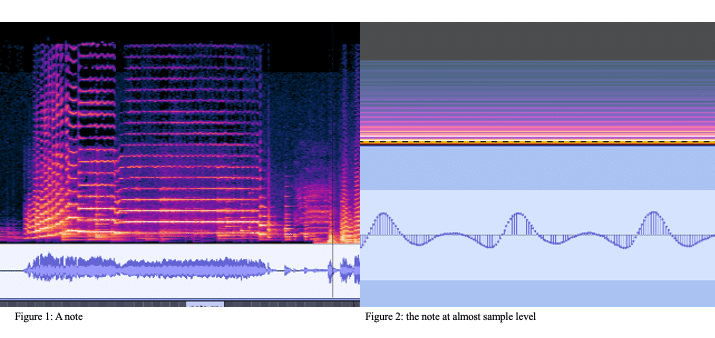
In this rendering, one commonly used in signal processing software (Kittler 2017), the peaks and troughs in the lower part of Figure 1 figure the waveform as varying sound pressure levels (in decibels), but the coloured lines of the upper panel show frequency components or harmonics present in the note. (To be precise, a Fourier transform applied using a Hanning window of 2048 samples.) The audio file loaded in the editor is itself highly processed since it came from an ffmpeg extraction of an audio-stream from a Youtube video stream transcoded into the common mp3 format. In other words, it comes from the digital compression algorithm, MP3, that formats other digital versions of the file in an easily transportable or streamable container (Sterne 2012). The sampling process used in digital recordings starts to appear in Figure 2 where the waveform amplitudes of Figure 1 split into the individual measurements of sound pressure taken 44,100 times per second in the pulse code modulation process.
In both figures, the note appears as multiple frequencies. The bright bands in the spectrograms, especially in Figure 1, suggest that at least 18 main frequencies are in play during the long trumpet note, as well as tightly stacked set of much lower frequencies associated with the piano, bass and drums running along the bottom. After the note, the shout appears as a much lower amplitude yet harmonically mixed waveform. In either case – note or shout – the waveform is not exactly unity, yet neither is it plural. Time has been folded, to put in Serrean terms.
1.4 Slightly more concrete but still abstract
It turns out that any note is very difficult to isolate as waveform, even if its fundamental pitch, A, 880 Hz, is well-enough known. The spectrogram shows the layering of different waves (the harmonics) as well as the ‘wideband’ (i.e. many frequencies) sound of the rest of the quintet (piano, bass, drums at this point) and the sound of the Philharmonic Hall itself. The amplitude waveform, similarly, shows the constant variation in sound pressure levels and wave energy as both the trumpet and other instruments intensify and diminish their pressure wave. A hit on the ride cymbal at the end of the note and the responding shout from the audience make the situation much worse. An overwhelming crowd of simultaneous inharmonic waves or ‘partials’ appear as vertical pillars in Figure 1.
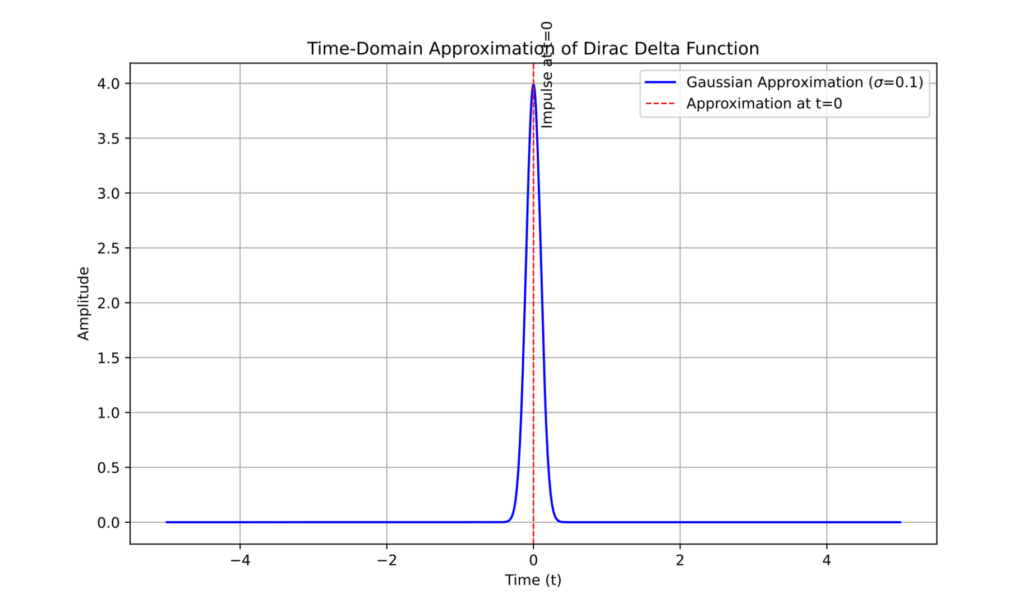
Figure 3: Pulse – the Diract delta function
Rather than trying to pull apart the note into its pure sine wave elements in spectral analysis, what if we sought to linger in the cascading inharmonics? A pulse, a single hit on the ride cymbal, suggests a way to do this. A pulse is the antithesis of a sine wave: short vs infinite; unpredictable vs finite amplitude. In the extremes of mathematical abstraction, a pulse known as the Dirac delta function or unit impulse is almost cosmogonic. The idealised pulse contains all frequencies (a flat frequency spread). It has infinite bandwidth, and its infinite amplitude contains all notes, but only ever so briefly that it remains an intense yet inaudible shock wave. A pulse is highly localised in time and place. It can, perhaps, be thought as an antidote to the endless periodicities of sine waves and the many engineering abstractions that they elaborate as signal processing. Pulses too are an abstraction, but in an obvious way (infinite bandwidth, infinite amplitude, infinitely brief).
Let us approach the note as a pulse, as the collapsing shock wave of many harmonic and inharmonic partials briefly assembled in a place-time pattern. The envelope – the overall shape including the attack, decay, sustain and release – of that note is full of resonances and harmonics combining from many vibrational processes in the Philharmonic Hall ensemble and its ongoing re-activations. Some components are high amplitude, some are low frequency, some are very long wavelengths like the tides or the El Nino Southern Oscillation. We might attend to the steeply ascending ladder of frequencies preceding the long note as the onset of the pulse. But equally so, the whole song could be the envelope of a pulse.
A pulse, then, is a counter-oscillator that relies on the envelopment of complex ‘outputs’ or processes into component signal elements (harmonics, partials, etc.), or even the much-loved sine and cosine waves. A complex event – a whole song as recorded at a concert – can not only be treated as the sequence of wave components, themselves understood as infinite duration and infinite energy sine waves. The pulsiform version of the event inverts infinite duration to localised time. For instance, considered as pulse, the average note of all sounds on earth, from oceans to winds, vehicles, industry, birds, animals, plants and water flows might be a pulse centred on C#, just as the last 150 years of industrialisation is often today modelled as a few hundred gigatonne pulses of atmospheric carbon dioxide to which the earth system, acting as a finite impulse response filter, responds by oscillating in the variations of pressure and heat called climate.
1.5 Partials all the way down
Streaming media, fuel in engines, data in undersea cables, breath in speaking, arterial blood flow, groundwater, tides, volcanism, and anything that gets pumped or blown might be amenable to pulse-thinking that slows down the smooth but abstract modulations and flows imagined in some versions of social and natural sciences. Helmreich affirms ‘the doubleness of waves—as material processes as well as formal abstractions’ (Helmreich, 2013, 145) as inviting consideration of ‘intercalation of two kinds of time’ (146) as well as ‘materialist explanation of subjectivity that simultaneously operates in a weirdly dis-embodied, even metaphysical way’ (145). In their partials, pulses compress many doublings, simultaneities and intercalated scales.
The experimental and ontological implications of feeling for pulses remain somewhat nascent, but might bring
- the trade-offs between times and structures in all patterns to the centre of the stage;
- the vectors of idealisation and concretisation running through all knowing into different alignments;
- the artefactual, ‘devic-ive’ aspects of pulses into wave generation.
This brings us back to the mid-flight improvised note of 12 Feb 1964. There is no distinct note, no tone, no shimmer without some pulsiform quantification derived from the device: a trumpet clamped to lips, an air column entrained with the breathing body of a Miles Davis, generates a standing wave at ~882 Hz. Wave-making arrangements as so well developed, but so are the means of locating and separating waves. The FFT, the ‘most important numerical algorithm of the 20th century’, and perhaps one of the most transmissive enablements of media-infrastructures (encoding and decoding video, audio, wireless and mobile data networks, and the pulsing light sources of optical fibre).
Only two musical instruments, trumpets and trombones, are said to be capable of producing the extreme pulsiform known as a shock-wave, a wave in which localised pressure variations exceed the speed of sound or ‘break the sound barrier’. The sound of such a shock-wave is not the boom of Krakatoa or a Concorde, but the transient cuivre or ‘sizzle’ (shimmer?) of certain higher-pitched notes. The February 1964 note and its answering shout locate the waveform in the pulsiform domain. A pulse can shimmer and occasion the experience of passionate immersion heard in that responding shout, or in other forms of attention, including scholarship via spectral analysis and its Fast Fourier Transform de-compressions.
The very thing that the spectrogram isolates in the notes – the bright bands of the harmonic series – are supported by the diffuse, less intense but wide-ranging partials of other wave-generating elements of the ensemble. Even the partials of the harmonic series include a range of values. They are not clear and distinct sensations, but bands of sensations.
ReferencesHelmreich, Stefan. 2013. ‘Potential Energy and the Body Electric: Cardiac Waves, Brain Waves, and the Making of Quantities into Qualities’. Current Anthropology 54 (S7): S139–48. https://doi.org/10.1086/670968.
Kimmelman, Michael. 2022. “A Notoriously Jinxed Concert Hall Is Reborn, Again.” The New York Times: Arts, September 29, 2022. https://www.nytimes.com/2022/09/29/arts/music/david-geffen-hall-reopening-lincoln-center.html.
Kittler, Friedrich. 2017. “Real Time Analysis, Time Axis Manipulation.” Translated by Geoffrey Winthrop-Young. Cultural Politics 13 (1): 1–18. https://doi.org/10.1215/17432197-3755144.
Miles Davis, dir. 2015. Stella by Starlight (Live at Philharmonic Hall, New York, NY – February 1964). Youtube.com. https://youtu.be/YI7qPHJ6tjA?t=105.
Music, Sony. 2025. “My Funny Valentine: Miles Davis In Concert.” Miles Davis Official Site. 2025. https://www.milesdavis.com/albums/my-funny-valentine/.
Oliver, B. M., J. R. Pierce, and C. E. Shannon. 1948. “The Philosophy of PCM.” Proceedings of the IRE 36 (11): 1324–31. https://doi.org/10.1109/JRPROC.1948.231941.
Rose, Deborah Bird. 2017. “Shimmer: When All You Love Is Being Trashed.” In Arts of Living on a Damaged Planet: Ghosts and Monsters of the Anthropocene, edited by Anna Lowenhaupt Tsing and Elaine Gan and Heather Anne Swanson Nils Bubandt. Minneapolis & London: University of Minnesota Press.
Sterne, Jonathan. 2012. MP3: The Meaning of a Format. Durham, N.C.: Duke University Press.